
Understand the purpose of each step
Connect the papers’ principles with equipment, working methods and observations in a training setting.


Understand the science. Explore the world of biopharma.
From research papers to laboratory learning. Develop your capabilities through experience in Korea.
Professional Pathway · South Korea · 2026
T1’s core papers connect biology, production processes and decisions grounded in evidence. Select a point to explore.
Explore how metabolism, cell growth and antibody production relate through the core research paper on CHO cell lines.
Do different cell lines respond to the same conditions in the same way?
Interpret findings · compare evidence · explain relationshipsRead the related paperTHหลักสูตรการเรียนรู้เชิงลึกด้านวิทยาศาสตร์ชีวการแพทย์และวิทยาศาสตร์ชีวเภสัชภัณฑ์ ณ สาธารณรัฐเกาหลี ประจำปี 2569
ENKorea Biomedical and Biopharmaceutical Sciences Immersion Program
KO2026 케이엑셀(K-XCEL) 한국 의생명과학·바이오의약과학 몰입형 교육 프로그램

Laboratory learning is central to K-XCEL, building on academic preparation through training, reflection and communicating understanding.
Connect the papers’ principles with equipment, working methods and observations in a training setting.
Distinguish observations from conclusions and explain how the information supports your understanding.
Exchange questions with instructors and peers while learning collaborative working and laboratory conduct.
This edition is tentatively planned at Yonsei K-NIBRT, pending venue and curriculum confirmation. Training institutions may differ between editions.
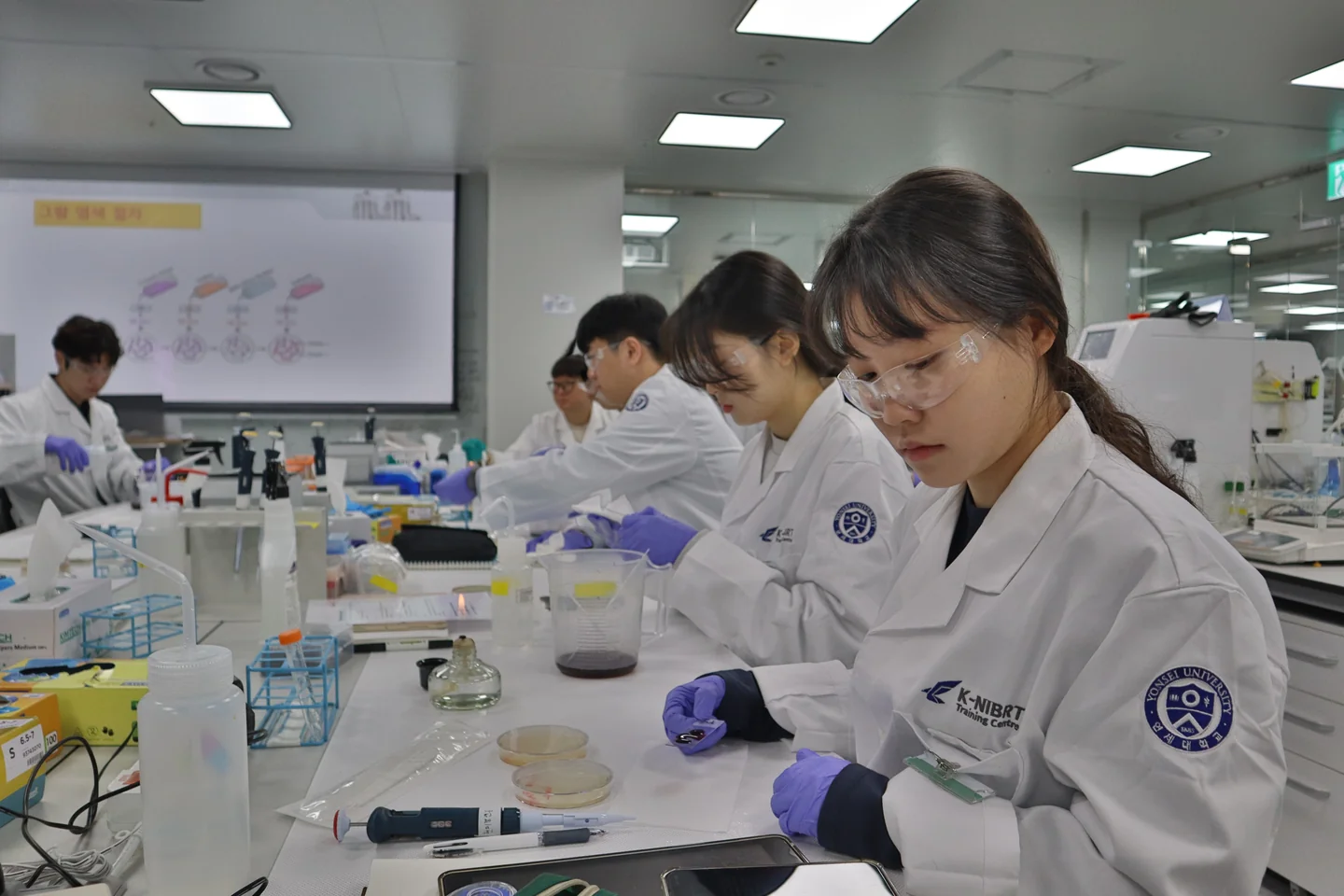
Explore Yonsei K-NIBRT and GTH-B, two biopharma training organizations under consideration for K-XCEL. The training institution may differ between editions.
The institution, venue and edition-specific curriculum await confirmation.
 INSTITUTION PHOTOGRAPH
Institution facilities and activities. Not photographs of K-XCEL participants.
A bioprocess workforce training center in Songdo, modeled on Ireland’s NIBRT. It connects scientific knowledge with practical learning in an environment resembling biopharmaceutical production.
The training center is located at Yonsei International Campus in Incheon.
The institution has facilities for cell culture, purification and biopharmaceutical process training.
The institution lists a dedicated hands-on bioprocess program for high-school students.
Each edition selects its training provider according to curriculum and availability; venues may change. The information above introduces institutional capabilities. K-XCEL’s venue, practical modules and hours follow that edition’s confirmed documents.
Apply directly to K-XCEL or extend your SCOPE KOREA experience through the Add-On route. Both include academic preparation before participation.
Assess readiness through reading, analysis and reasoning. Candidates meeting the preliminary criteria proceed to confirmation and academic preparation.
Preliminary threshold: ≥50% of 280 points · confirmation subject to capacity and conditions.
Check available roundsArticle-Based MCQs with Reasoning use two research papers. Choose from five options and explain your reasoning with supporting evidence.
Select an available round in the system and join Google Meet at least 15 minutes before the examination.
Scope & sample questionsBiomedical & Biopharmaceutical Scientific Understanding
Cell Biology · Antibodies · Product QualityBioprocessing & Biopharmaceutical Process Analysis
Purification · Chromatography · Purity & RecoveryRead the original sources in advance. Use these questions to organize your understanding before selection and practical learning.
Connect differences between cell lines with metabolism, growth and antibody quality.
Read the original paperWhat question does the study ask, and what does it compare?
How do the data support differences between cell lines?
How do the findings relate to production?
A reading and learning framework to use alongside your round’s preparation requirements.
Start with the research question, study overview and key figures or tables, then return to the relevant details.
Organize the question, methods, findings, conclusions and limitations, identifying the evidence behind each point.
Connect your reading with cells, antibody production, purification and quality to understand the purpose of each step.
Practice explaining the main idea, what the evidence means and its biopharmaceutical relevance clearly and concisely.
Standalone and SCOPE Add-On participants prepare to the same academic standards.
An opportunity to synthesize research, explain its central ideas and connect the findings with biopharmaceutical science through concise academic presentation.
ACADEMIC RECOGNITION AWARDS
The activity’s highest overall recognition, based on assessment against program criteria.
Recognises distinguished scientific understanding and analysis.
Recognises distinguished, clear communication of research ideas.
Awards follow the panel’s assessment against activity criteria and are not guaranteed to every applicant.
Each certificate reflects a different activity and set of conditions. Know which elements you have completed and qualified for.
Issued by the Training Partner in Korea for the officially confirmed curriculum, training scope, hours and completion conditions.
For participants presenting in 3-Minute Biopharma Research Insight in accordance with program criteria.
Eligible examination participants also receive a selection-participation certificate. Keep your own learning records and work; check each institution’s requirements when using these in a portfolio.
Selection and laboratory program registration are separate stages. Check eligibility and confirmed inclusions before committing.
For the standalone K-XCEL admission route.
4 days / 3 nights · 29 November–2 December 2026 South Korea
Request fees & inclusionsSelection-ranking discounts and SCOPE Add-On benefits follow round announcements. Do not assume discounts can be combined.
Start with the information that supports your decision, then review the round’s announcement to prepare fully.
Explore the curriculum through institutional information and real photographs, with tentative plans clearly identified.
2025Yonsei K-NIBRT institutional photo from its 2025 mRNA training gallery, not K-XCEL participants.
Yonsei University K-NIBRT Explore the recordRead K-NIBRT’s high-school training information. The actual K-XCEL curriculum must be confirmed for the edition.
K-NIBRT · Official website Explore the recordCore papers and T1 scope connect reading, analysis and evidence-based communication.
TECH Education · T1 Explore the recordYonsei K-NIBRT is the tentative host for the late-2026 edition. Institutions and curricula may vary. Institutional photographs illustrate the setting; they are not evidence of K-XCEL participant attendance.
Read the program sourceTwo main rounds: participant selection examination, then a laboratory practical program in South Korea.
T1 is a secondary-school track for learners interested in biomedical science, biopharmaceuticals, biotechnology and production processes, ready to read English papers and reason from evidence. Check round-specific eligibility in the application system.
Biomedical & Biopharmaceutical Sciences
Currently offering 1 track: T1. Check the examination date and eligibility for your chosen round.The selection examination fee is separate from laboratory program registration. Review inclusions and program conditions before confirming your place.
สมัครสอบ | Apply for the examination
ขอบเขตข้อสอบ | Examination scope

Build your understanding, learn with new peers, and explore how biomedical and biopharmaceutical science connect with your future.
SCIENCE. EXPERIENCE. EXCELLENCE.