
From test scores to visible competencies
Reading PISA 2022 alongside four SCOPE KOREA projects: what published work can tell us about secondary students’ scientific reasoning, communication and revision.
Read the article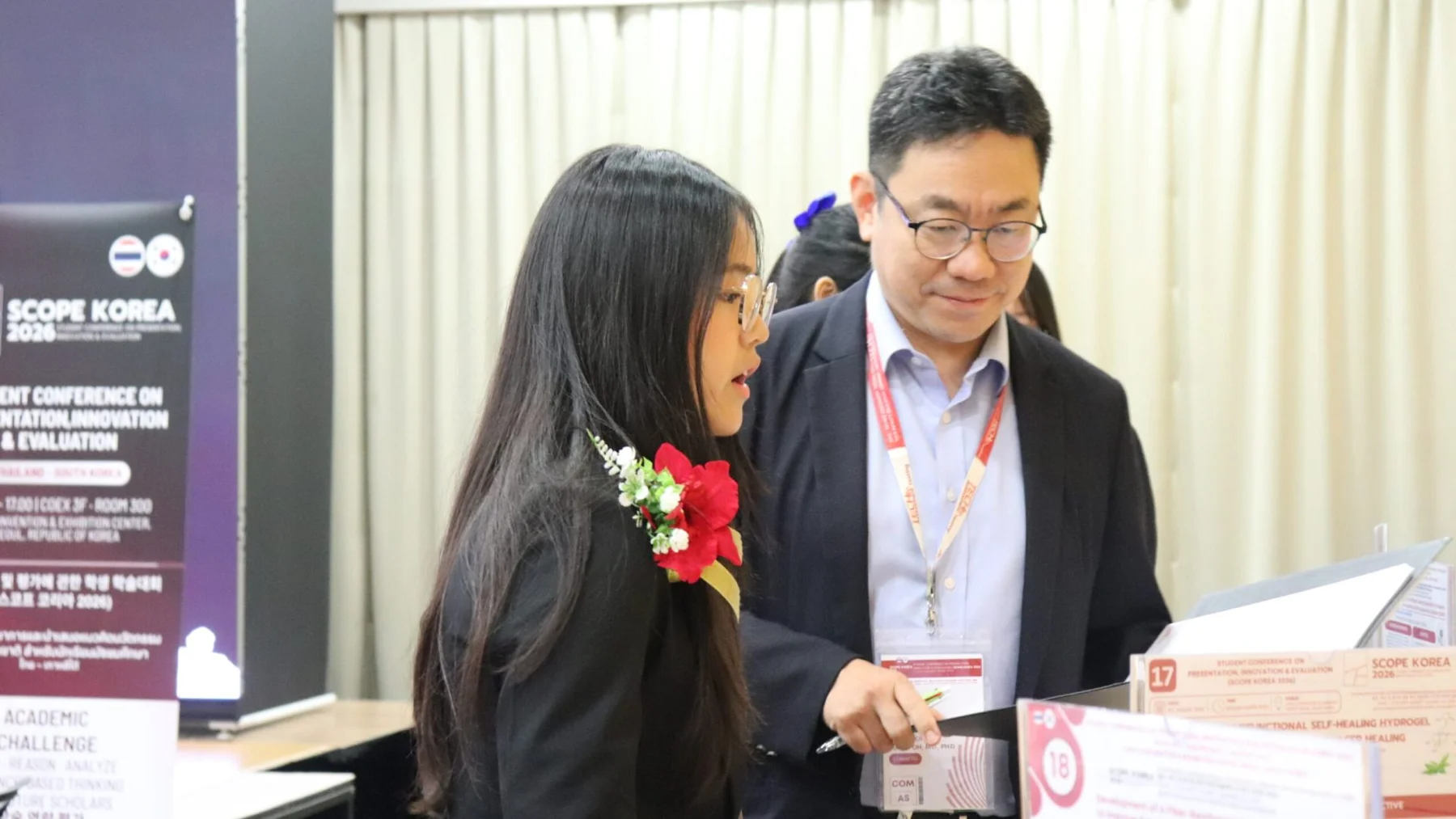
When a student stands beside a poster and is asked, “Why did you choose this method?”, the final answer is only part of the conversation. How was the question framed? Which evidence mattered? What would change the student’s mind? These questions make a learning process visible enough for others to examine and discuss.
This article connects national education indicators with SCOPE KOREA project records to propose a fuller understanding of students’ potential. It helps students, teachers and families look for meaningful evidence and identify development that can continue after an event.
Look beyond a single result
- Scores illuminate one part of learning; work samples and explanations reveal more of the process.
- Credible work connects its question, method, evidence and conclusion so that others can trace the reasoning.
- Track development through work collected over time, and distinguish satisfaction from demonstrated skills.
What Thailand’s indicators invite us to ask
PISA 2022 provides context on 15-year-olds’ learning. The indicators below come from the same assessment year but use different scales and should be read separately.
Share of students · OECD average 76%
Out of 60 · OECD average 33
Source: OECD · 15-year-olds · assessment year 2022 · rounded estimates as reported
Our reading of these indicators leads to a practical question: how can students have more opportunities to use knowledge on questions that require further reasoning, explanation and revision? Such experiences can begin with a nearby problem, without waiting for an ambitious topic or expensive equipment.
National indicators describe a target population in that assessment year. SCOPE participants have different backgrounds and participation pathways. Selected projects or program scores cannot be treated as a before-and-after comparison with PISA.
Knowledge that can be explained can be examined
Well-designed tests can assess knowledge and reasoning under common conditions. Academic projects also expose choices students make: selecting a problem, defining variables and deciding which conclusions the evidence can support. Reading both forms of work together allows more precise questions about a learner.
PISA’s creative-thinking framework attends to generating diverse ideas, generating creative ideas, and evaluating and improving ideas. Used as a lens for reading a project, this invites questions about alternatives the student considered and the reasons for revising the work. [3]
For example, “the prototype works” leaves important questions open: under what conditions, compared with what, and with what repeatability? What was learned when it did not behave as expected? A careful account of limitations and the next test can reveal more understanding than an unsupported confident conclusion.
Read the archive with its context intact
The SCOPE KOREA archive reviewed here contains 54 records from three editions. It identifies project titles, presenters and schools, with supporting detail of varying completeness. Edition counts describe this archive, not quality scores or the total number of participants.
The four cases below illustrate different kinds of task; each has a summary and a video link. The discussion is this article’s analysis, not judges’ assessments, and the cases are not ordered by quality or awards.
SCOPE KOREA | Student Conference on Presentation, Innovation & Evaluation
Four projects, four ways to read scientific reasoning
One bicycle, and the reasoning behind a mechanism
Hydrostatic Bicycle with Integrated Planetary Gear Transmission
The project summary proposes combining hydraulic transmission with planetary gearing for smooth ratio changes and a compact structure. It describes expected benefits conditional on successful prototyping; we therefore read it as a design direction that needs further verification.
The useful learning question is about trade-offs. How would the student weigh efficiency, system mass, leakage and maintenance, and justify what can be compromised?
If a prototype is available, how could input and output energy be measured under comparable conditions for a fair comparison with the existing system?
What this evidence does not establish
The reviewed summary does not provide efficiency-test data, so it does not establish lower energy use or readiness for practical deployment.
A smart cane: from a sensor reading to a meaningful signal
Development of a Smart Cane for posture monitoring to improve elderly safety
The project describes combining an angle sensor and microcontroller with a cane to monitor posture and issue alerts. The record shows a proposed connection between an engineering mechanism and an older user’s needs.
Our proposed lens separates detecting a preset angle from reducing falls: they are different outcomes. The learning opportunity is to translate user needs into testable measures and explain the distance between what was measured and what is hoped for.
What determines the alert threshold, and how would false alerts and missed signals be recorded under appropriately qualified supervision?
What this evidence does not establish
The reviewed summary does not report a clinical study with comparative data; it does not establish reductions in falls or pain.
Chitosan and seashells: making “suitable” measurable
Development of Chitosan–Seashell Powder Composite Materials for Biomedical Cast Applications
The project explores a chitosan–seashell powder composite for biomedical cast applications. Its stated objectives include investigating mixture ratios and mechanical properties, connecting a resource-use idea with material requirements.
With several formulations, the student needs to choose relevant properties and control other conditions for comparison. “Strong” needs a measurement method, units and consistent conditions. Sustainability also requires its own supporting evidence.
If adding seashell powder makes the material harder but more brittle, how would intended-use requirements guide the formulation choice, and what evidence would change it?
What this evidence does not establish
The summary does not supply raw test values or patient-safety validation. This analysis concerns the learning task, not certification for medical use.
Fruit peels and a homebuilt instrument: questioning the measurement
Antioxidant activity of fruit peel watste using the dpph assay with a spectrophotometer and homebuilt photometer
The summary reports a DPPH study of lime, orange and passion-fruit peel extracts, comparing a spectrophotometer with a homebuilt photometer at 30 and 60 minutes. The task therefore includes both sample comparison and scrutiny of the measurement method.
The student’s summary reports result patterns and agreement between instruments. This opens a useful question: does finding the same ordering mean the instruments are interchangeable? Answering requires calibration, measurement error and repeated observations.
If the instruments rank samples identically but return very different values, how would agreement be checked, and how should repeated measurements be shown?
What this evidence does not establish
We reviewed the published summary, not the raw data. We do not independently validate the instrument or translate the laboratory findings into health benefits.
Keep evidence of the thinking journey
To make one presentation part of a trackable learning process, we propose keeping traces of decisions alongside the finished work. This table is a discussion framework for teachers and families, not SCOPE’s official scoring rubric, and it is not used to rank the four cases.
| What to look for | Evidence to discuss | A useful question |
|---|---|---|
| Question and scope | Research question, operational definitions and study conditions | What evidence could actually answer this question? |
| Evidence and method | Data tables, units, collection method, references and repetitions | How far could another person check or reproduce the work? |
| Reasoning | How the evidence supports a conclusion, including alternatives | Which alternative explanations remain possible? |
| Communication | Poster, presentation record and responses to relevant questions | Can the student explain the work independently and identify what remains unknown? |
| Revision | Versions before and after feedback, with reasons for accepting or declining changes | How is the later decision better supported by evidence? |
A useful portfolio might contain the initial question, supporting data, a poster, feedback and a short revision note. Looking back, the student should be able to explain personal contributions, assistance received and any digital or AI tools used, with sources checked before citation.
Cross-language communication adds a clarity challenge, but fluency should not stand in for the whole quality of reasoning. Teachers can first invite explanations through diagrams, data and a comfortable language, then develop the presentation language so that subject understanding and communication can be considered separately.
From an article to conversations at home and school
01Before choosing: what will the student do independently?
Look at expected work, difficulty, the adviser’s role and opportunities for feedback. Invite the student to explain which questions connect with personal interests. Read the learning process alongside the locations and activities.
02During the project: what is uncertain, and how will it be checked?
Ask open questions: “What does this dataset lead you to believe?” or “How would you explain a different result?” Leave room for reflection rather than supplying the answer, and help locate resources or expertise when the task exceeds an appropriate scope.
03After the event: how will the next piece of work be different?
Choose one actionable piece of feedback, keep the revised work and explain the reason for the change. Friendship and inspiration have value in their own right; academic development becomes clearer when accompanied by work samples or explanations.
When considering TechEd programs, start with the work involved: IMEDDAT focuses on aptitude development and testing, SCOPE KOREA on presentation and evaluation, and K-XCEL on competency development through experience and learning. Consult the edition you are considering for its actual eligibility, activities and conditions.
Returning to that single poster, a lasting capability is being able to say: “What do I know, what supports it, and how will I find out more?” Helping students build that explanation, with evidence others can examine, is a learning goal teachers and families can support in any classroom.
Methods, open questions and a next step
Scope: an editorial analysis of OECD reports and published project records held in TechEd Website, checked on 1 October 2026. This is not a systematic literature review and no new participant data were collected.
Counting: one SCOPE project directory supplies 54 records: 15 from edition 1, 18 from edition 2 and 21 from edition 3. A combined key of edition, project title and presenter name yields 54 distinct keys. A second display file contains the same key set and is not added to the total.
Completeness: 49 records contain at least one summary section and 52 contain distinct video links. These describe availability in the dataset, not guaranteed playback or completeness of every video, and do not represent all program participants.
Case selection: four records were purposively chosen for having a title, presenter, school, summary and video link, spanning all three editions and engineering, assistive technology, materials and experimental tasks. This is neither a random sample nor a winner selection or representation of all project quality. Analysis is based primarily on summaries, not video assessment or laboratory replication.
Interpretation: the suggested questions, reading criteria and evidence to retain are this article’s analysis, not statements attributed to students or judges. Names and schools follow the published directory, with no additional personal information.
Key limitations: we do not have individual pre/post scores, a rubric with checked assessor agreement, a comparison group, or records for participants whose work was not published. We do not calculate improvement rates, establish program effects or infer admission or career prospects from these cases.
From an archive to a study of development
A future outcome study should define competencies and criteria in advance, collect comparable work at multiple times, record participation and missing data, align assessors’ interpretation of the rubric, and report uncertainty. Attributing change to the program would require a design that addresses students’ initial differences and other influences. This is a proposed future data-collection approach, not a study already conducted.
TECH EDUCATION operates the programs discussed and publishes this article, creating an interest in the subject. This is not an independent evaluation and has not undergone external peer review. Future updates should be grounded in inspectable evidence.
Follow the original evidence
- 01OECD · PISA 2022 Results (Volumes I & II): Thailand (2023)
Science proficiency at Level 2 or above · assessment year 2022
- 02OECD · PISA 2022 Results (Volume III): Thailand (2024)
Mean creative-thinking score · maximum 60
- 03OECD · PISA 2022 Assessment and Analytical Framework (2023)
Creative-thinking framework: generating, evaluating and improving ideas
- 04TECH EDUCATION · SCOPE KOREA GEN 01 (2025)
Published project directory and summaries · first edition
- 05TECH EDUCATION · SCOPE KOREA GEN 02 (2026)
Published project directory and summaries · second edition
- 06TECH EDUCATION · SCOPE KOREA GEN 03 (2026)
Published project directory and summaries · third edition
OECD reports and website dataset checked: 1 October 2026 · Individual video links appear in the case studies and directories