
From assessors’ questions to stronger student research
Turn feedback into a traceable revision plan, with learning research, examples from the SCOPE KOREA archive and a practical record of decisions and evidence.
Analysis and practical tools · The reviewed records do not pair assessors’ feedback with before-and-after work.
Read & put into practice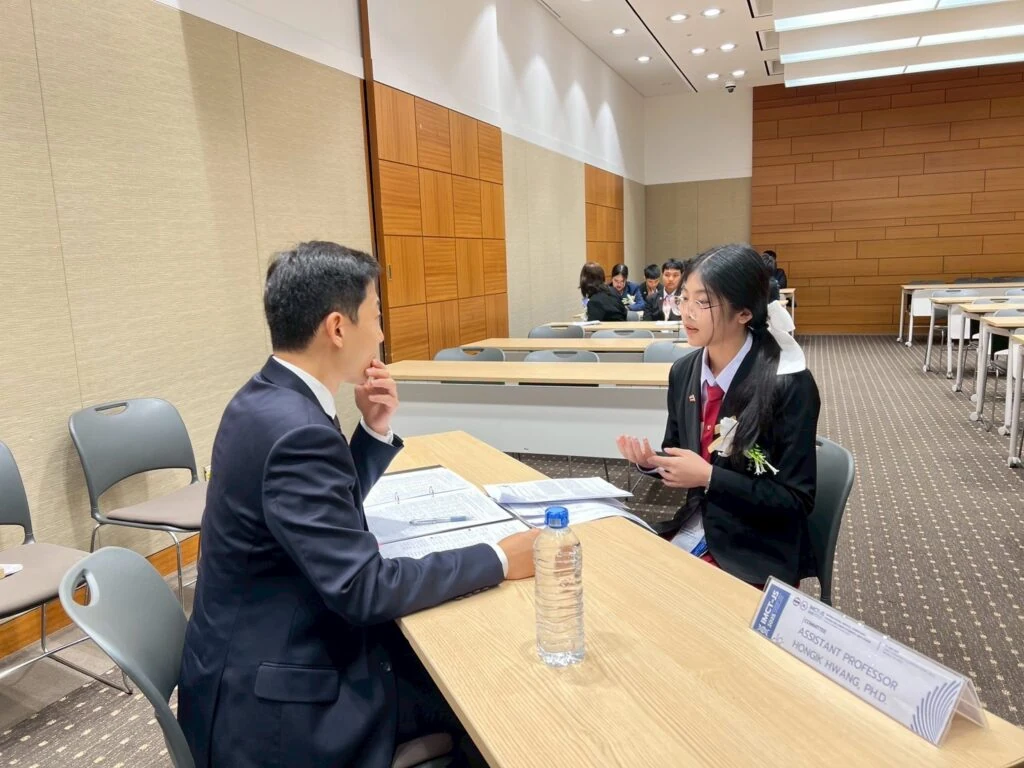
A question-and-answer session may last only minutes, yet one question can open weeks of further inquiry. Its value lies both in the response on the day and in what the student chooses to do next. This article shows how feedback can become a reasoned decision with a record that can be revisited.
The starting points are feedback research and public SCOPE KOREA project summaries. Practice questions and revision plans below are our proposals, not quotations from assessors or actions attributed to the named projects. The reviewed records do not contain that linked evidence.
Key ideas to take away
- Feedback needs understanding and an opportunity to act.
- Clarify claims, methods and reasoning before polishing the presentation.
- Record changes, deferred changes and the reasons for each.
Turn a feedback concern into a next action
Choose a concern to explore a practice example, not an actual participant’s assessor feedback.
The claim reaches beyond the evidence
- A question to explore
- For which group and conditions does the evidence apply?
- Put it into practice
- Rewrite the conclusion with its conditions and separate future aims.
- Evidence to keep
- Two conclusion versions and the reasoning for the scope.
What research tells us about useful feedback
Wisniewski and colleagues’ meta-analysis of 435 studies found a positive average effect, with substantial variation across feedback conditions. It does not mean that expert comments automatically improve every project by the same amount. [1]
EEF recommends planning how students will receive and use feedback. [2] Our practical proposal is to end each review with one manageable action—such as redefining a measure or improving a graph explanation—and arrange to revisit the resulting evidence.
Sort the feedback before choosing an action
Understanding and scope
Does the question concern what is being investigated or how far a conclusion can reach? Start by aligning the research question with the stated scope.
Evidence and method
Is the concern about comparisons, units, instruments or repetitions? Identify what is missing before deciding whether to collect more data or narrow the conclusion.
Communication
When evidence exists but is hard to find, improve graph labels, captions or the order of reasoning. Clearer presentation helps readers; it does not itself strengthen the underlying data.
Practice questions inspired by real projects
Case one: Hydrostatic Bicycle with Integrated Planetary Gear Transmission, in SCOPE KOREA GEN 01, proposes a hydraulic and planetary-gear system. [3] Our practice question is: how could efficiency be compared fairly? A possible next step is to define comparable conditions and measurements. Without test data, communicate the intended design benefit rather than a proven energy saving.
Case two: Development of a Smart Cane for posture monitoring to improve elderly safety, in GEN 02, describes an angle sensor and alerts. [4] Our practice question asks whether the evidence demonstrates posture detection or fewer falls. A possible revision separates sensor performance from user outcomes and identifies work needing qualified supervision. We do not claim that the student received this question or completed these revisions.
A one-page record that makes revision visible
| Record | What to write | Why it matters |
|---|---|---|
| Original version | File, date and research question at that point | Identify the actual comparison |
| Feedback | Use a traceable note or video timestamp; distinguish quotation from paraphrase | Reduce recall errors |
| Interpretation | Explain in your own words what needs checking | Check shared understanding |
| Decision | Revise, investigate or defer, with reasons and constraints | Show ownership of the work |
| Evidence of the revision | Attach the changed passage and evidence, not just “done” | Enable another reader to check |
| Next question | Remaining uncertainty, whom to consult and a review date | Keep inquiry moving |
Listen carefully and retain your own reasoning
Students need not implement every suggestion. If it changes the research question beyond the project’s scope, explain what can be addressed now and what belongs in future work. A reasoned decision to defer is different from dismissing a comment before understanding it.
One possible response is: thank you for this perspective; the current evidence supports this narrower claim, we will clarify this point, and we will retain that question for future work. Courtesy is most useful when backed by a decision that others can examine.
How teachers and families can support the next step
Invite the student to choose one priority and allow actual revision time before the next meeting. Adults can ask about reasoning, sources and uncertainty without writing the answer. Page count and confident delivery alone do not show what the student has improved.
For a scored comparison, use comparable criteria and conditions and document the assistance received. Check SCOPE’s assessment page for the applicable published criteria. [5] These reflection tools do not replace assessors’ scores or decisions.
From reading to your next small step
Six checks before closing the conversation
Apply these to your current project and choose a feasible next step.
A worthwhile step may be a more precise question, not a more ambitious claim.
Selections stay on this page, are not submitted and reset when the page is reopened.A good question does more than invite an answer: it helps the learner decide what to investigate next. Linking feedback, decisions and evidence makes a project a continuing space for thought.
How this article was developed
This analysis draws on a meta-analysis, teaching guidance and public Website records reviewed on 2 October 2026. Cases illustrate the distinction between aims, methods and evidenced outcomes; they were not selected to rank students.
No verified feedback record is paired with two versions of the same student’s work. We therefore report neither actual assessor comments nor measured revision gains. The templates and questions are editorial proposals, not validated measurement instruments.
TECH EDUCATION operates the programs discussed and publishes this article, creating an interest in the subject. This is a source-based editorial analysis, not an independent evaluation, and has not undergone external peer review.
Explore the original sources
- 01Wisniewski, B., Zierer, K. & Hattie, J. · The Power of Feedback Revisited (2020)
Frontiers in Psychology, 10:3087 · Meta-analysis of 435 studies; abstract and methods reviewed
- 02Education Endowment Foundation · Teacher Feedback to Improve Pupil Learning (2021)
Guidance and recommendations poster · Opportunities for students to use feedback
- 03TECH EDUCATION · SCOPE KOREA GEN 01 (2025)
Hydrostatic bicycle project, record 9 · Published summary retained in the Website
- 04TECH EDUCATION · SCOPE KOREA GEN 02 (2026)
Smart cane project, record 2 · The record contains no revised work or individual feedback log
- 05TECH EDUCATION · SCOPE KOREA Assessment (2026)
Published assessment criteria, distinct from the article’s practice tools
Sources checked October 2, 2026 · Please contact the team with a source if you identify a correction. Contact the team
Explore the related programs
Review the aims, activities and edition-specific conditions before choosing your next experience.
SCOPE KOREASCOPE KOREA | Student Conference on Presentation, Innovation & Evaluation