
From the classroom to biopharma: a learning map for secondary students
Connect cells, proteins, separation, data interpretation and quality with biopharmaceutical manufacturing, using a worked fictional dataset and preparation ideas for K-XCEL.
Read & put into practice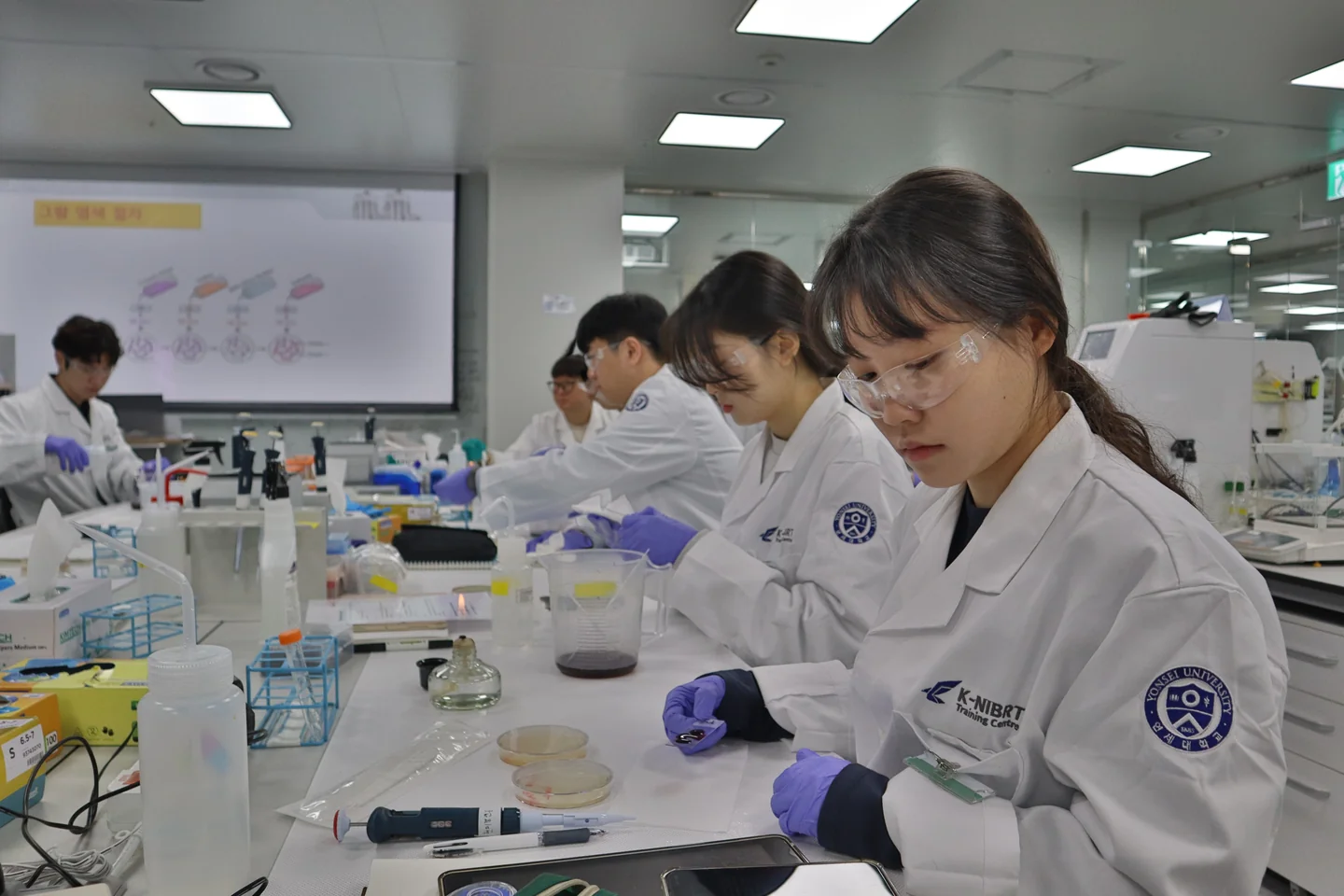
Biopharmaceuticals may sound distant from secondary school. Yet the starting questions are familiar: how do cells make proteins, how do we read a graph, and how do we know whether a product has the intended quality? This article maps those connections before moving into specialist detail.
For students at this stage, the aim is to understand reasoning, examine evidence and ask better questions. The map can support preparation for K-XCEL or classroom learning. A short educational activity is not a professional qualification or permission to manufacture medicines for patients.
Key ideas to take away
- Biology, chemistry, mathematics and communication meet in one process.
- Amount, purity, recovery and quality answer different questions.
- Prepare by reviewing the scope and confirmed plan for your program round.
Explore five learning connections
Select a connection for a question, a learning task and evidence to retain. This is a preparation map, not an operating procedure.
Understand the living system
- A question to explore
- How is the cell connected to the product?
- Put it into practice
- Draw a reading-based concept map and check the terms.
- Evidence to keep
- A one-page map with its source.
Start with the cell and follow the product
FDA describes many biologics as originating in living systems, often with more complex structures than conventional medicines. [1] Here, protein production is a teaching example linking cells and gene expression. Not all biopharmaceutical products follow one manufacturing route.
An FDA process overview connects cell systems, production, harvest and purification with the resulting product. [2] We adapt that broad picture into secondary-level questions: what should we understand, what data should we inspect, and what remains unsupported at each point?
How school subjects connect with real questions
| What you learn at school | Biopharma question | A learning task |
|---|---|---|
| Biology: cells and proteins | What does the cell do, and which protein is of interest? | Draw a cell-to-product concept map from a reading |
| Chemistry: properties and separation | How does the target differ from other components? | Explain separation principles without conducting a procedure |
| Mathematics: ratios and graphs | What is the denominator, and are the datasets comparable? | Label units, calculate an example and explain limitations |
| Data skills: recording and checking | Can another person trace the number to its source? | Record the source, date and calculation method |
| Language: precise communication | How can findings and uncertainty be explained across backgrounds? | Write a one-page explanation in your own words |
Read the numbers before deciding what is better
Fictional calculation exercise: start with 100 mg of target protein. Method A recovers 80 mg of target within 100 mg of total protein after separation. Method B recovers 60 mg within 63.2 mg of total protein. Every value is invented for this exercise, not a laboratory or program result.
In this simplified model, purity equals target-protein mass divided by total-protein mass after separation, multiplied by 100. Recovery equals recovered target mass divided by initial target mass, multiplied by 100. Real analytical methods may define or estimate purity differently; check the measurement method before applying these formulas to actual data.
| Method | Modeled purity | Modeled recovery |
|---|---|---|
| A | 80 ÷ 100 × 100 = 80% | 80 ÷ 100 × 100 = 80% |
| B | 60 ÷ 63.2 × 100 ≈ 94.9% | 60 ÷ 100 × 100 = 60% |
Quality is a way of thinking throughout the process
FDA describes quality oversight across systems, methods, facilities and manufacturing controls. [1][2] For students, our application is a set of modest habits: label units, retain original observations, make corrections traceable and keep unexpected results visible.
When a result attracts attention, ask who measured it, what was measured, how, and how it can be checked. Practical equipment use, materials handling and controlled areas belong under the institution’s teaching plan, risk assessment and supervision. This article provides a conceptual map, not a manufacturing or laboratory protocol.
Prepare for the K-XCEL edition you are considering
K-XCEL connects scientific reading with competencies and practical experience. [3] Start with the relevant scope and readings, then build a glossary you can explain independently—for example, cell, target protein, purity and recovery. Check the track, grade level and actual conditions in that round’s guidance. [4]
The Website introduces Yonsei K-NIBRT and GTH-B as institutions under consideration. Each edition’s venue, topics and hours follow its confirmed documents. [3] The laboratory photograph depicts institutional training; it does not promise every pictured activity to applicants.
Before learning: prepare three questions
Choose one question each about cells, processes and quality; record what you have already read.
During learning: record reasons alongside observations
Separate what you observe, the instructor’s explanation and your own interpretation; ask when unsure.
After learning: explain a piece of evidence
Choose one item of evidence and explain its source, interpretation, conclusion and limits to a peer.
Explore your interests without closing other doors
An interest in how cells work can lead to mechanistic biology; an interest in separation can lead to chemistry or processes; an interest in checking numbers can lead to data and quality. These are invitations to explore, not an aptitude diagnosis or a career guarantee.
A suitable secondary-level output might be a concept map from a reading, a comparison of public datasets, or an explanation of why certain numbers cannot yet support a conclusion. Clearly explaining a limitation can be a meaningful learning achievement.
From reading to your next small step
Prepare to learn with purpose
Check your understanding and next readings; you do not need mastery before beginning.
Bring purposeful curiosity and a willingness to examine your own understanding.
Selections stay on this page, are not submitted and reset when the page is reopened.Biopharma becomes more approachable when classroom ideas connect with purposeful questions. A valuable first step is knowing what the evidence says, what it does not yet say and what you want to understand next.
How this article was developed
We reviewed FDA explanatory material and its 2023 manufacturing overview alongside K-XCEL and Website guidance on 2 October 2026. The selection supports a secondary-level concept map, not professional standards or operating instructions.
All table values are fictional and the formulas use a simplified mass model. The photograph shows attributed institutional activity, not K-XCEL outcomes. No license, professional qualification or admission entitlement is claimed for learners.
TECH EDUCATION operates the programs discussed and publishes this article, creating an interest in the subject. This is a source-based editorial analysis, not an independent evaluation, and has not undergone external peer review.
Explore the original sources
- 01U.S. FDA · Biosimilar and Interchangeable Biologics: More Treatment Choices (n.d.)
Sections on biologics and manufacturing quality · Not treatment advice
- 02Downey, C. & Welch, J. / U.S. FDA · A Quick-Start Guide to Biologics Manufacturing (2023)
SBIA presentation, slides 7 and 18 · Process overview and quality systems
- 03TECH EDUCATION · K-XCEL (2026)
Program identity, learning focus and edition-specific training arrangements
- 04TECH EDUCATION · ขอบเขตการสอบ / Exam scope (2026)
Check reading materials, tracks, grade levels and the relevant examination round
Sources checked October 2, 2026 · Please contact the team with a source if you identify a correction. Contact the team
Explore the related programs
Review the aims, activities and edition-specific conditions before choosing your next experience.
K-XCELK-XCEL | Korea eXcellence through Competency, Experience & Learning